
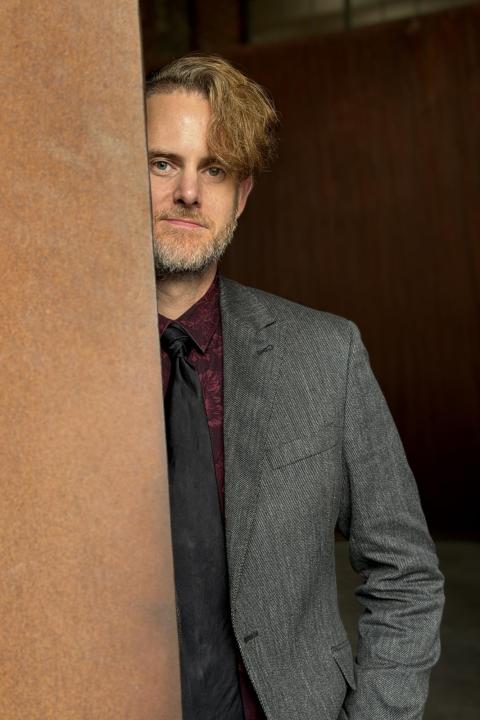
Kevin Baldwin
For media inquiries, please contact Media Relations
Kevin Baldwin, D.M.A., M.F.A., is a saxophonist, composer, and interdisciplinary artist who has been making his mark on the global stage for over a decade. His advanced degrees in contemporary and experimental music have shaped his conceptual practice, challenging common perspectives of music and visual art practices through experimentation, theory, and philosophy. Baldwin's use of a wide range of media, such as sound, digital fabrication, and artificial intelligence, creates experiences that provoke questions about objects and ideas we perceive, often revealing what we may not have considered.
Baldwin has received awards and residencies as a composer, including Akademie Schloss Solitude in Stuttgart, Germany. He has also been a featured saxophonist in solo and chamber settings in select venues, from New York's Symphony Space to the Beijing Normal University in China. The New York Times has called his performance "precise and energetic." Recently, pianist Anne H. Goldberg-Baldwin's debut album Permutations featured Baldwin's composition "Broken Language," and his work "body, and... and..." was featured on Leanna Keith's solo bass flute album body of breath.
Additionally, Baldwin has participated in collective exhibitions and international collaborations, as well as solo shows in the Greater Boston area. His recent works have been featured across Boston in MassArt X Sowa with the exhibition "Farm to AI-Table." His intermedia collaboration with Kledia Spiro, "Drawing in Air," was featured at the Kingston Gallery. Baldwin has collaborated on multimedia projects including numerous dance films, and has been invited to international festivals, receiving a Critics’ Choice Award at the Tagore International Film Festival in 2020.
- Selected collaborations: Hypercube, Ensemble Mise-En, loadbang, Ensemble SurPlus, and Columbia University's Gagaku Ensemble
- Selected reviews: “…precise, energetic...” –The New York Times, “…at times jarring.” –The Boston Globe
- Selected venues: Miller Theatre (NYC), National Opera Center (NYC), The Paramount (Boston, MA), and Schloss Solitude (Stuttgart, Germany)
- Critic & Writer for 10 years at I CARE IF YOU LISTEN
- Selected solo and group interdisciplinary art exhibitions: "Art + Science" at Spartanburg Art Museum (Spartanburg, SC), "eyeMusic" at Bacon Free Library (Natick, MA), and "Meet Me There" at MassArt x SOWA (Boston, MA)
- Selected film festivals: EXCHANGE Choreography Festival and NACHMO Film Festival
- Instrumental: Saxophone, didgeridoo, and hichiriki
- Interdisciplinary artistic proficiencies: Max/MSP, Arduino, Fabrication, Graphic Scores, Artificial Intelligence
- Commission grant recipient, Judy Center for Applied Research (2015)
-
School NameMassachusetts College of Art and DesignState or ProvinceMassachusettsDegreeMaster of Fine Arts (MFA)Date Degree Received
-
School NameUniversity of Washington-Seattle CampusState or ProvinceWashingtonDegreeDoctor of Musical Arts (DMA)Field of StudyCompositionDate Degree Received
-
School NameManhattan School of MusicState or ProvinceNew YorkDegreeMaster of Music (MM)Field of StudyContemporary Classical Music PerformanceDate Degree Received
-
School NameUniversity of the PacificState or ProvinceCaliforniaDegreeBachelor of Music (BM)Field of StudyCompositionDate Degree Received
-
School NameUniversity of the PacificState or ProvinceCaliforniaDegreeBachelor of Music (BM)Field of StudyMusic Education