
From Africa to Appalachia

The kora's 21 strings are made of fishing line. Sissoko tunes the instrument by pushing the leather bands up and down the neck to adjust the strings.
Photo by Rob Hochschild
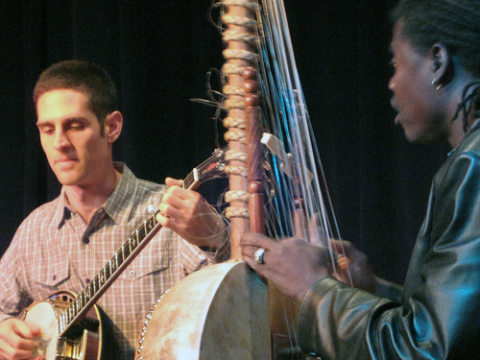
The first time Sissoko heard him play, Stone said, he knew they could collaborate. Sissoko told the clinic audience, "La musique, c'est universale."
Photo by Rob Hochschild
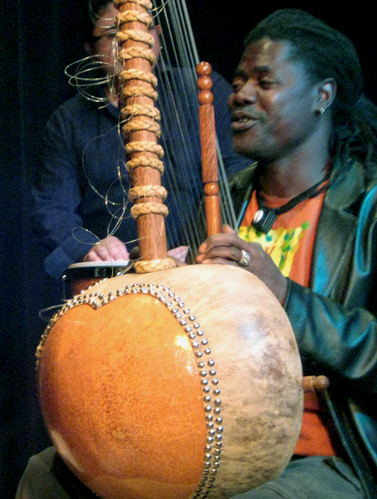
Sissoko's mother was a griot before him. The group performed a song she used to sing to traders on market day as well as a song that called love "a sickness that the doctor can't cure."
Photo by Rob Hochschild
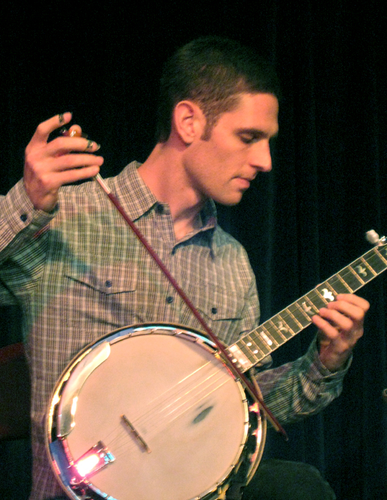
Meeting Sissoko was part of Stone's journey of musical exploration that eventually took him to Africa to research the roots of the banjo, which came over with the slaves.
Photo by Rob Hochschild
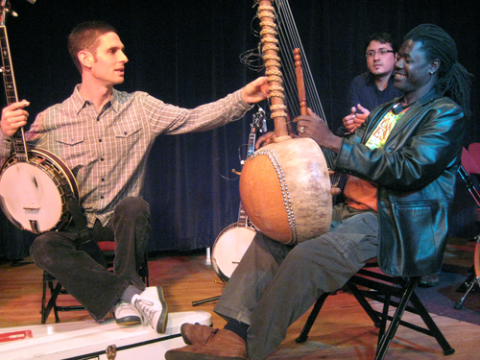
The body of a kora is a dried-out calabash gourd with a cowskin head. The instrument always sounds better, Stone said, after it's slept in the sun.
Photo by Rob Hochschild
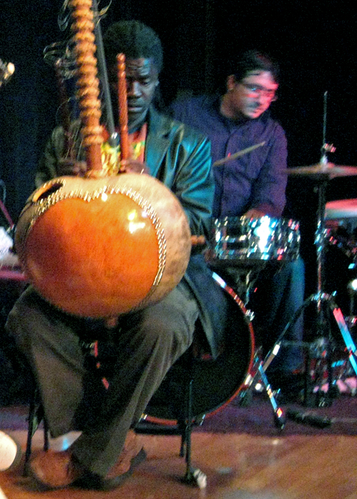
Percussionist Ricardo Gonzalez had to quickly change instruments after his own calabash drum broke the morning of the clinic.
Photo by Rob Hochschild
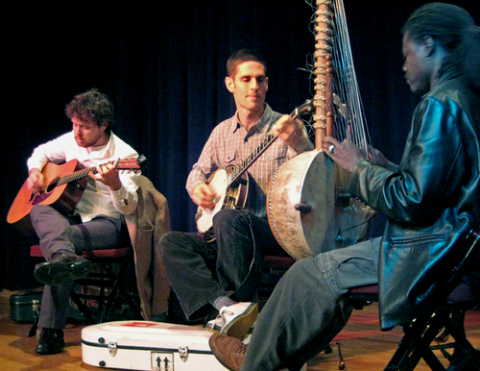
Colorado-based guitarist Grant Gordy (left) also performs with jazz/bluegrass great David Grisman.
Photo by Rob Hochschild
If Stephen Foster turned the clock a few generations back, Susanna's swain might've held not a banjo but a kora on his knee. The instruments are cousins: The predecessors of the modern-day banjo originated in Africa, crossing over with the slaves.
Perhaps that's why, when Canadian banjo whiz Jayme Stone met Mansa Sissoko, a Malian kora player and hereditary griot singer/storyteller who now lives in Quebec City, things started to click—or twang.
Stone didn't stop there: four years later, he traveled to Africa to research his instrument's roots. The experiences led him to collaborate on an album, Africa to Appalachia, with Sissoko.
On October 8, the two musicians brought their 26-string collaboration to Berklee. With guitarist Grant Gordy and percussionist Ricardo Gonzalez, they performed several songs that interworked traditional Malian melodies and rhythms with bluegrass instruments and influences—casting a new light on both cultures.
Click on the photo to learn more about the clinic.