
Andrew Bird: A Study in Artful Contradiction
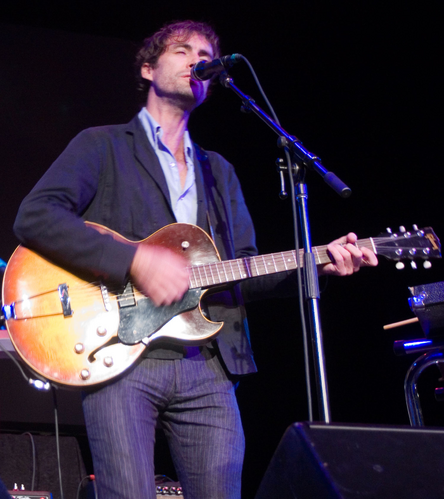
Singer/songwriter/multi-instrumentalist Andrew Bird performs for Five-Week Summer Performance Program students August 2.
Photo by Tony Luong
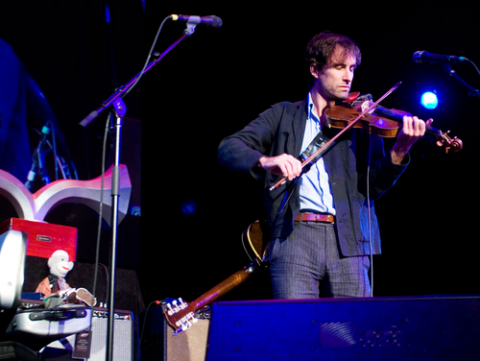
"Don't get too discouraged. It's really hard getting started," Bird tells the students.
Photo by Tony Luong
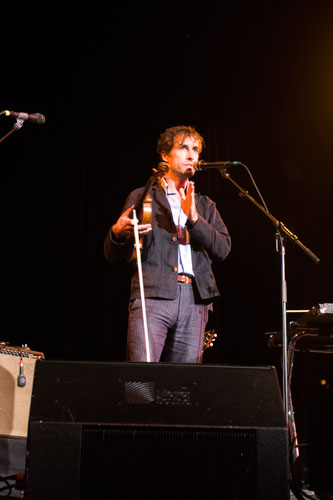
Bird answers questions from the audience.
Photo by Tony Luong
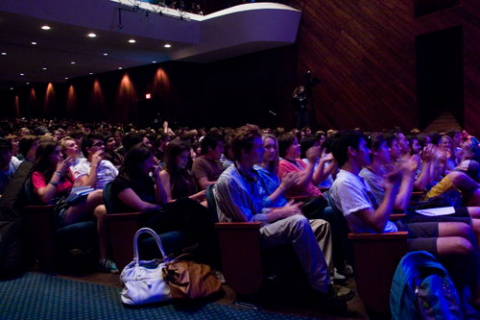
Bird gives a clinic to a packed audience at the Berklee Performance Center.
Photo by Tony Luong
He is a one-man show. Alternating between a violin, glockenspiel, and guitar, Andrew Bird also sings and uses looping pedals. And whistles—so proficiently that it sounds like another instrument. Then there are the whirling, exposed double-horned Leslie speakers. What emanates from it all is music that defies definition; all at once, it's epic yet intimate, artfully composed yet improvised. And for a softspoken man, Bird delivers a big sound, enough to pulsate the room with some serious energy and put a respectful hush over the crowd. The singer/songwriter, whose style is most commonly associated with the indie-rock scene, penned lyrics that made enough of an impression on one audience member to tattoo them on her arm.
During a clinic for Five-Week Summer Performance Program students on August 2, Bird—who holds a bachelor's degree in violin performance from Northwestern University and often plays with a band—performed several songs solo and entertained questions about process, influences, and a small toy monkey perched near those enormous speakers. Here's a sampling of what was heard in the Berklee Performance Center that afternoon.
On looping:
I never thought I would use it live. I started seven or eight years ago, just because the violin is a linear instrument. I accidentally started doing it live. It's a really great compositional tool. I'm not looking to replace an ensemble or orchestra or something like that.
On the Suzuki method:
I'd say Suzuki has a lot to do with the musician I am now because I learned a very pure form of Suzuki where I didn't look at a note of music for the first 10 years. . . it kind of has some principles of folk music but you're playing Bach and Mozart.
On influences:
I haven't really been influenced by anyone for a long time. There was a student phase that I went through from around 18 to 26 where the records were the textbooks. I was ravenous, soaking it up. And I would jump from one genre to the next every couple of weeks and get deeply into it and want to participate and make that music. As a violinist, I stopped listening to violinists when I was 20 or 21 and I got really into jazz, especially more traditional jazz. I got into Lester Young and Coleman Hawkins and Johnny Hodges. . . I found fluidity that maybe I found missing in a lot of classical music.
Advice for a "crazy dedicated songwriter" (the one with the tattoo) who wants to end up like him someday:
Don't get too dogmatic about something. . . it's a strange thing when your job is to daydream. Give yourself enough mental space and room to be able to think about certain things. I find walking in unfamiliar places to be very inspiring. . . . Try writing without your instrument in your hand. You can start to fall into muscle memory.
On how performing live influences the creative process:
Playing songs live is really instructive every time I play. It's the changing that makes them better. It's truer to my everyday process. I wake up, make coffee, and keep music flowing all day even as I'm doing menial things.
On the monkey:
I get superstitious about certain things and when you do a bunch of shows, it's like, why didn't that show go right? Oh, the monkey wasn't there. I get a lot of handmade gifts. This one was particularly endearing. It's supposed to be modeled after me.